

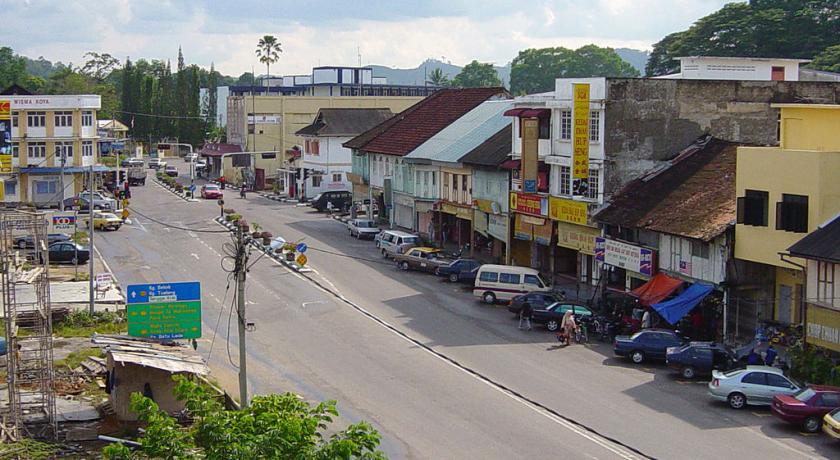
Description
Kuala Krai (alternative spelling: Kuala Kerai) is a district (jajahan), a town and a parliamentary constituency in the interior of the State of Kelantan in the north-east of Malaysia. Historically it was once known as Kuala Lebir.
Kuala Krai territory
Kuala Krai territory is a landlocked administrative area in the centre of the State of Kelantan in the north east of Malaysia. The land is hilly, and before the 20th century the entire area was tropical rain forest. The territory contains the confluence of two major rivers, the Lebir and Galas, to form the Kelantan River, which continues flowing on some 70 km northwards through one of the most densely populated flood plains on the Malay Peninsula to its estuary in the South China Sea near the State capital of Kota Bharu.
As transport links improved during the 20th century, people moved into the area to take advantage of the abundant land available for farming. A railway was constructed in the 1920s through the undeveloped interior of Malaysia to link Kelantan State with the main centers of population on the west coast. This line ran through Kuala Krai territory, and settlements became established along its route. Road links followed, and towns and villages grew to cater for the mainly agricultural population. Rubber production was increasingly important throughout Malaysia, and many rubber tree plantations were set up in this area. Later, the country-wide shift to oil palm in the 1970s and 1980s saw the establishment of oil palm plantations in the territory, some of which replaced rubber.
Infrastructure developed to support the population and by the end of the 20th century Kuala Krai town had become a busy thriving town, and the administrative centre for the territory.
Population
The population of Kuala Krai territory was 117,800 in 2009.
History
The history of the town of Kuala Krai started with the building of the East Coast Railway in the 1920s. Before that, the only settlement of any significance in the area was called Batu Mengkebang. The area was remote and travel was by river: there was a weekly service from Kota Baru to Batu Mengkebang via Pasir Mas and Tanah Merah, run by Duff Development River Steamers under contract to the Kelantan Government.
The opening of the railway line made a significant difference to the remote interior of the state of Kelantan. River traffic downstream from Kuala Krai was soon completely replaced by rail travel, and the railway became very popular with what was still quite a large planting fraternity in the interior of the state. The town grew as a centre of trade and supplies for the surrounding area.
More recently, road traffic past the town has significantly increased with the proximity of Federal Route 8 which opens a direct road link between Kota Bharu and the Malaysian capital, Kuala Lumpur. The suburb of Gucil has developed along this road to take advantage of the increased traffic.
Some important events in the history of the town:
1917 Kuala Krai hospital was opened
1926 (December) The great flood, the worst flood in the history of the town, which affected both Kelantan and the neighbouring states of Terengganu and Perak
1930 (19 June) Visit of Sir Cecil Clementi, Governor of the Straits Settlements and High Commissioner for Malaya 1930-1934, after which he travelled on the newly constructed railway to Pahang
1941 The Japanese invasion force landed at Kota Bharu on 8 December and allied troops retreated; 2nd Lieutenant Butters and his section of Mahrattas were left behind in Kuala Kerai with a battalion of the Royal Malay Regiment; before leaving the town they attempted to impede Japanese progress using explosives to prevent the railway line being used by the advancing Japanese
1945 Immediately after the war ended, Kuala Krai was controlled by the communists for about six months before the arrival of allied forces
1946 Serious flooding affected the town
1961 Opening of the Mini Zoo
1967 (26 Nov) Severe flooding: the water level of the Kelantan River rose to 86 ft (26 m), which is 36 ft (11 m) above the normal level Large areas of the town were flooded up to first floor level.
1967 (Dec) forced landing of an M.S.A. plane at Kuala Kerai which nearly had fatal consequences to the passengers
Transport
Kuala Krai has excellent transport links. The railway station operated by Keretapi Tanah Melayu (KTM) is on the East Coast Line which runs from Tumpat and Wakaf Bharu (close to Kota Bharu) right through the interior parts of Kelantan and Pahang to Gemas on the west of the peninsula, where it joins the West Coast Line from Singapore to Kuala Lumpur. The town has good road links, with Federal Route 8 passing close to the town. It is also located on the western bank of the Kelantan River, along which there are regular boat services up-river from the town.
Museum and Mini Zoo
Kuala Krai Mini Zoo is managed by the District Council and open to the public. It is home to a variety of animals, including a male elephant called "Salleh", monkeys, bears, deer and various birds. The site extends to about 10 acres (40,000 m2), and also includes a Mini Museum displaying photographs and documents relating to the history of Kuala Krai, as well as a number of preserved animals. The mini zoo was opened in 1961 and is the only zoo to specialise exclusively in animals from the Malaysian jungle.
Source https://en.wikipedia.org/wiki/Kuala_Krai_District
Address
Kuala Krai
Maleisië
Lat: 5.539596081 - Lng: 102.201454163